



How to Choose a Demulsifier for Crude Oil Emulsion By our Application Engineering Team Crude oil emulsions don't break on their own fast enough. Pick the wrong demulsifier — or the wrong dosage — and you'll watch separator underflows run milky, BS&W numbers refuse to drop, and your refinery feedstock ends up outside spec. This article walks through the practical factors that actually decide which demulsifier you should be running.
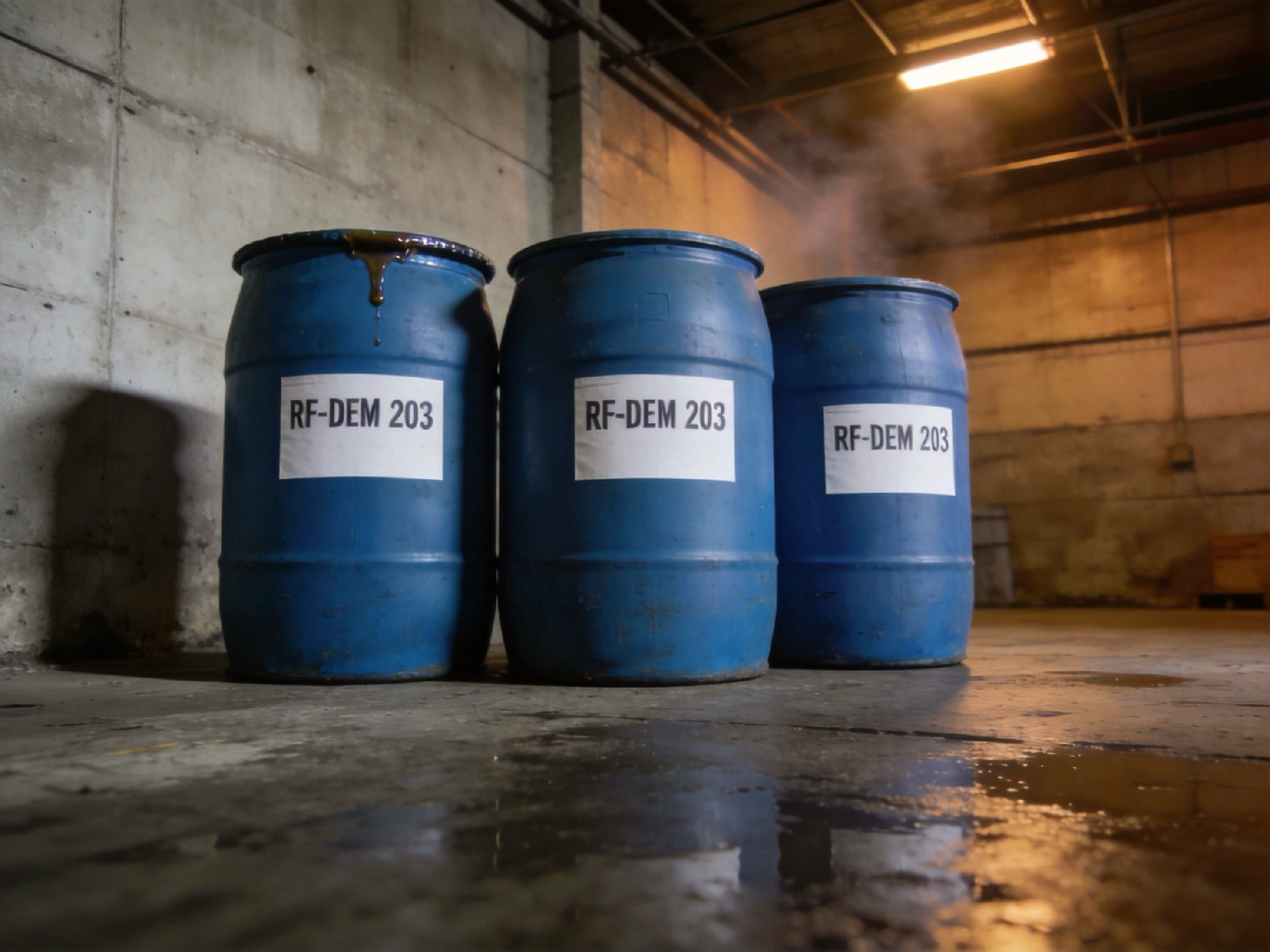
Demulsifier drums ready for shipment. Formulation is chosen after jar-test results confirm a match with the crude in question.
Why Emulsions Form in the First Place
When crude leaves the wellhead it almost always carries produced water. Under the high-pressure, high-shear conditions of the reservoir and production tubing, that water disperses into tiny droplets surrounded by a film of natural surfactants — mainly asphaltenes, naphthenic acids, and fine solids like iron sulfide and clay. The film stabilizes the droplets against coalescence. The higher the shear, the smaller the droplets, and the harder the emulsion is to break.
A demulsifier works by diffusing to that film, weakening or displacing it, and letting the droplets merge again. The molecule has to be amphiphilic enough to reach the interface but not so water-loving that it just dissolves into the produced water and does nothing. That balance is what changes from one crude type to the next, and it's also what makes "one product fits all" a recipe for disappointment.
Six Things We Look At Before Selecting a Demulsifier
A typical selection conversation starts with these six questions. The answers narrow the chemistry down quickly.
• Crude type. Light crude / condensate, waxy crude, heavy crude, or aged emulsion. Heavy crudes usually need oil-soluble demulsifiers; high water-cut systems often respond better to water-soluble or dual-injection programs.
• Water cut. Below 30%? Between 30 and 70%? Above 70%? Higher water cuts push toward water-soluble or reverse demulsifiers, and retention time requirements change.
• Temperature. Separator temperature sets the working window. Low temperature means the demulsifier has to work harder at the interface; very high temperature (above 150 °C on some offshore platforms) limits which polymer backbones survive without hydrolysis.
• Target BS&W and OIW. Crude leaving the separator usually has to be below 0.5% BS&W; produced water going overboard often has to be below 30 ppm OIW, sometimes below 5 ppm depending on local regulations. Tighter specs mean the demulsifier has a harder job.
• Retention time available. Offshore separators typically give 30–45 minutes. Onshore gun barrels and heater treaters can afford one to several hours. Less time means you need a faster-acting chemistry — often oil-soluble — and sometimes a higher dose.
• Injection method. Continuous injection upstream of the first-stage separator is the default. Batch injection into a slop-oil tank, or spot treatment of emulsion dumps, uses different chemistries.
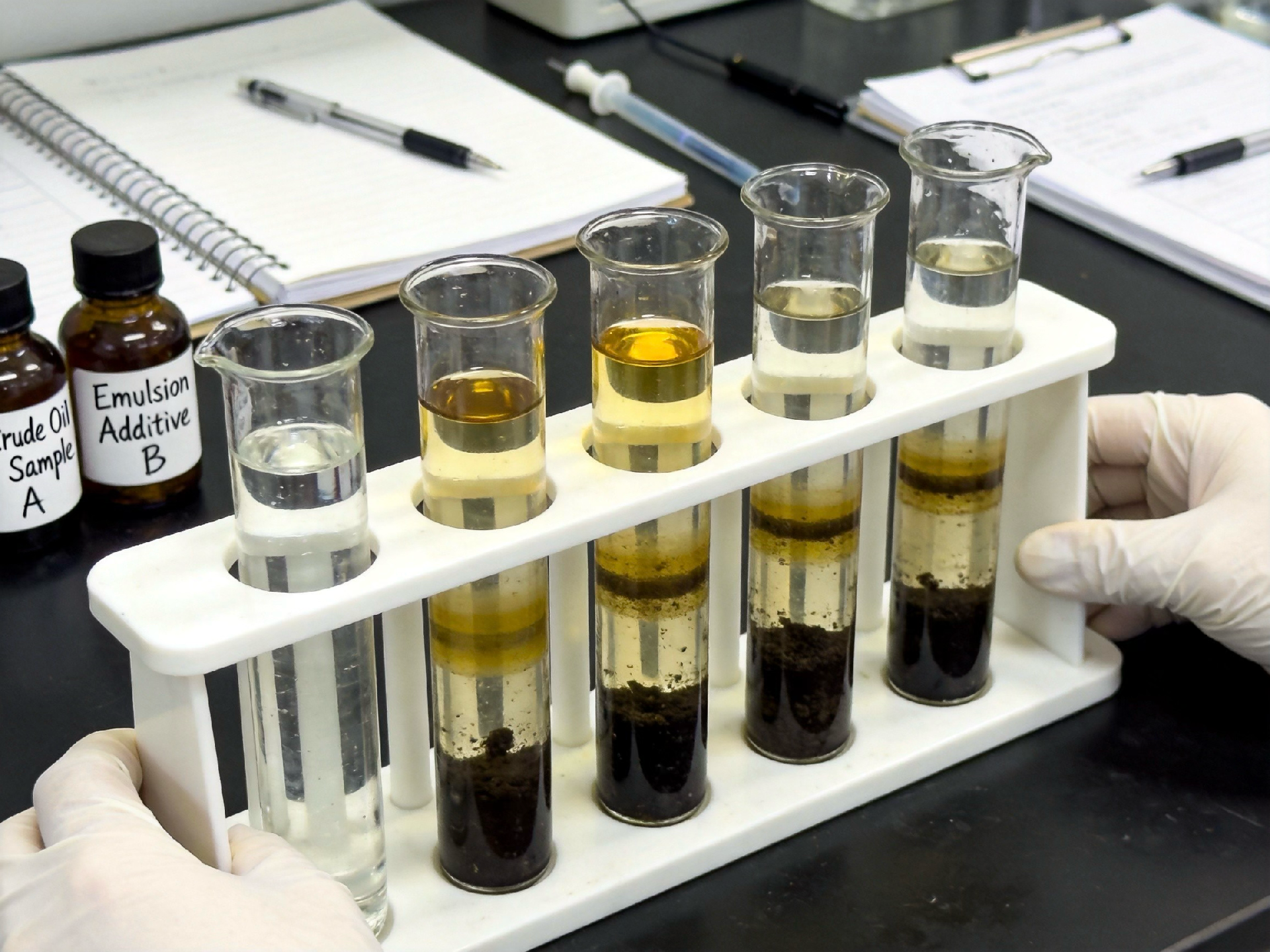
Jar test in progress. The same crude, same temperature, same dose — but different chemistries. The right cylinder is the one that clears within the separator's available retention time.
The Lab Test Before the Field Trial
Before we send anything to site, we run a bottle test. A representative crude sample goes into a graduated cylinder with the candidate demulsifier at several dose levels, held at the separator temperature, and we track three numbers over time: how fast the water drops out, the BS&W of the resolved oil, and the OIW of the separated water.
If a demulsifier clears the oil to 0.5% BS&W in 20 minutes at 50 ppm but the field separator only gives 30 minutes and the crude has seasonal temperature swings down to 35 °C in winter, we're not done. That's where we start asking about the site's operating envelope before finalizing the recommendation.
Typical performance targets we work toward: BS&W ≤ 0.5% in crude; OIW ≤ 30 ppm (often ≤ 5 ppm for overboard discharge); clear water phase with minimal rag layer; dose 10–100 ppm depending on crude.

Oilfield production facility. The separator train is where demulsifier selection actually gets validated — lab numbers have to translate to continuous operation.
When a "Good" Demulsifier Stops Working
This happens on almost every field eventually. A chemistry that performed well for months starts leaking water. Nine times out of ten the crude has changed — different well came online, water cut shifted, or seasonal temperature dropped. It's rarely a problem with the demulsifier itself.
Our field engineers usually start by re-running a bottle test with a fresh crude sample. If the original chemistry still clears in the lab but not on site, the issue is usually one of these:
• Injection point is downstream of where the emulsion actually forms
• Mixing energy at the injection point is too low, so the demulsifier isn't reaching the interface
• Separator temperature has dropped below the demulsifier's working window
• A new well has brought in fines or H₂S that change the film chemistry at the droplet surface
Fixing it is usually a small adjustment — change the injection point, increase the dose, or switch to a slightly different formulation. Occasionally it means reformulating from scratch, which is why having a bench with 40+ demulsifier chemistries actually matters in practice.

Field dewatering station. Injection points, mixing conditions, and downstream interactions with corrosion and scale inhibitors all affect demulsifier performance in practice.
Why Crude Type Drives the Decision
The four crude types we handle most often need noticeably different approaches:
• Light crude / condensate. Thin film, water drops out relatively easily. Low-dose oil-soluble demulsifiers usually do the job.
• Waxy crude. Wax crystals trap water and make the emulsion mechanically rigid. The demulsifier has to penetrate the wax, so we look for formulations with high wax-displacement capability. Temperature control at the separator is critical.
• Heavy crude. High viscosity, often high asphaltene content. Needs strong oil-soluble chemistries, sometimes combined with heat.
• Aged emulsion / slop oil. These have had weeks or months to stabilize. They almost always need a dedicated reverse demulsifier, often applied warm and at higher dose.
There's also the question of whether the field runs one crude or blends several. Blends can behave completely differently from either parent crude, and we test them as a blend rather than assuming.
Injection Point Matters More Than Most People Think
You can run the best demulsifier in the world, but if it's injected too far downstream it won't have time to work. We usually recommend injection as close to the wellhead as practical, or at least upstream of the first-stage separator mixing valve, so there's shear to help distribute the chemistry through the emulsion.
Some fields inject at the wellhead, some at the first-stage separator inlet, some at both. The choice depends on pipeline length, residence time before the first separator, and whether the emulsion has time to become too stable before the demulsifier reaches it.
What We Supply
For demulsifier selection, we run a formulation set across light crude / condensate, waxy crude, heavy crude, and aged emulsion / slop oil applications. Each formulation is tuned for the operating conditions typical of that crude type, and we support selection with bottle tests on the customer's crude.
All products are supplied as concentrates — oil-soluble, water-soluble, or custom emulsion — and can be diluted on site to match the existing dosing system. Low-toxicity, biodegradable options are available for offshore applications that need to meet OSPAR guidelines or MARPOL Annex I discharge limits for produced water.
Full documentation is available: TDS, MSDS, COA per batch, and the compliance paperwork most NOCs and oil service companies ask for.
Send us a crude sample. We'll run bottle tests at your separator temperature and come back with a recommended demulsifier, dose range, and injection guidance.
Request a Sample →
This article reflects our application team's field and lab experience. Demulsifier performance is highly dependent on crude composition and operating conditions — the targets and approaches described here are typical, not universal. If you have a specific crude or separation problem, we're glad to look at the actual sample.