


Sour gas and sour produced water are problems that don’t negotiate. H₂S is acutely toxic well below the levels you can smell for long, it attacks steel through both sour cracking and uniform corrosion, and pipeline gas specifications typically cap it at 4 ppm. If your gas is running at hundreds or thousands of ppm, you need a treatment program — and the first real decision is whether that program should be regenerative or non-regenerative. This article focuses on where non-regenerative scavengers fit, and why triazine is usually the right answer inside that box — along with the one operational problem that gives triazine a bad name when it’s misapplied.
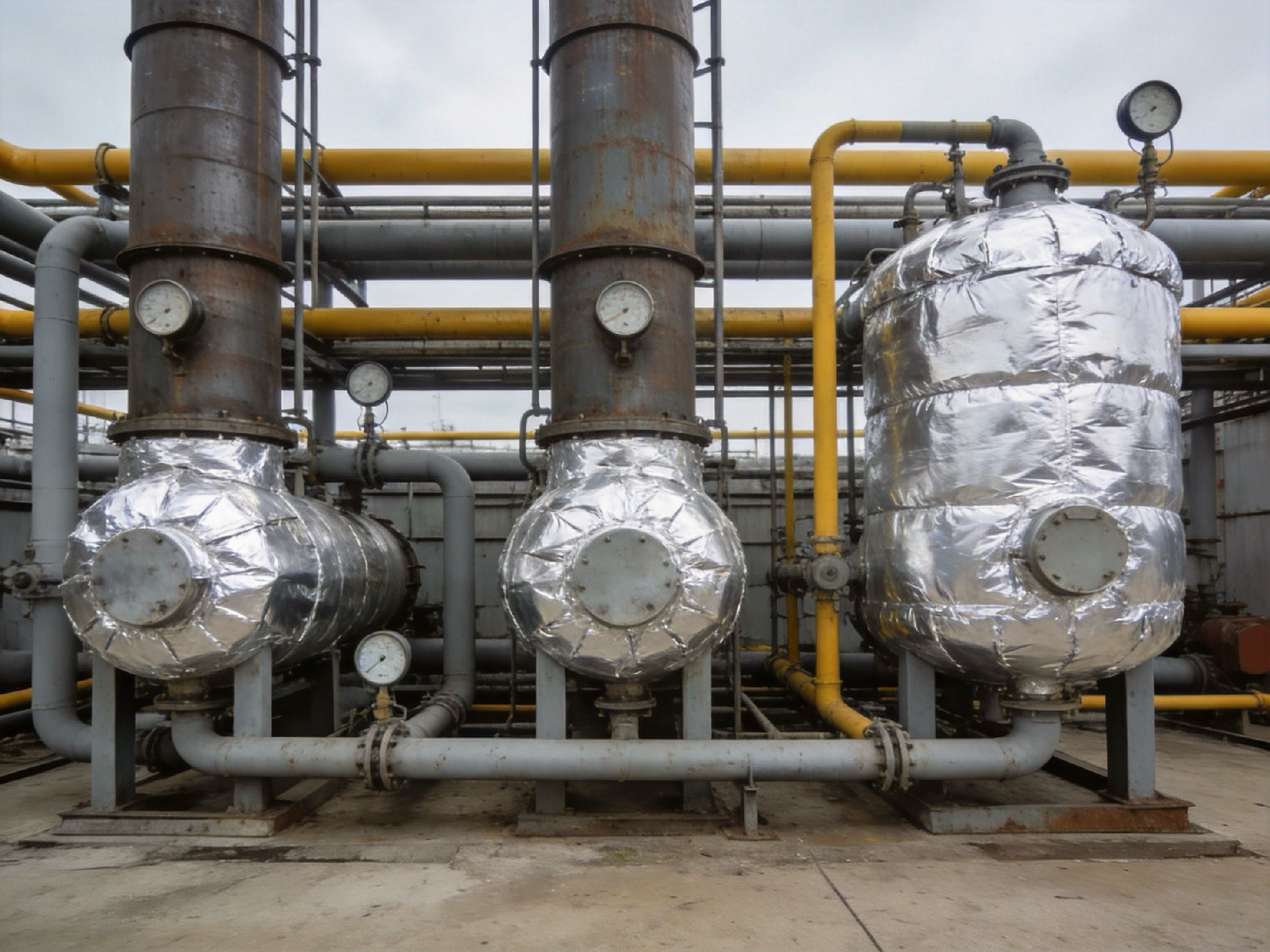
Gas processing facility. Large sour-gas streams with steady H₂S loads run regenerative amine units; smaller or intermittent loads are usually treated with non-regenerative scavengers injected upstream or in a contact tower.
First Decision: Regenerative or Non-Regenerative?
The dividing line is gas volume, H₂S load, and how continuous the problem is.
Regenerative systems — typically an amine absorber (MDEA or similar) circulating through a regenerator, often with a Claus unit downstream — make sense when you’re processing large gas volumes with high, steady H₂S content. The amine is stripped and reused, so chemical cost per kilogram of sulfur removed is low. The catch is capital cost: the contactor, regenerator, reboiler, and sulfur recovery train are a major installation, and they only make economic sense when the sulfur load justifies running them 24/7.
Non-regenerative systems — triazine, zinc oxide, solid oxidizing media, and a few others — react with H₂S once and are then discarded with the produced water or as spent media. They require almost no capital: a chemical tank, a dosing pump, and sometimes a small contact tower. They’re the standard choice for wellheads, gathering systems, satellite batteries, batch-treated wells, and any operation where the H₂S load is intermittent, seasonal, or simply too small to justify an amine plant.
As a rough rule of thumb, below a few hundred kilograms of sulfur per day, non-regenerative scavenging almost always wins on total cost. Above a ton or two per day, the chemical consumption of a once-through system starts to pay for an amine unit. The grey zone in between is where we do the math case by case.
Why Triazine Dominates the Non-Regenerative Side
Triazine is a six-membered ring molecule with three nitrogen sites. The industry-standard product is a water-soluble triazine made from monoethanolamine (MEA-triazine), usually supplied at around 40–60% active in water. Each triazine molecule can theoretically scavenge two molecules of H₂S, converting them into non-volatile sulfur compounds that stay dissolved in the water phase. In field terms: you dose it into the gas or water stream, and the sulfur comes out the other end as a non-toxic, non-corrosive salt — no solids, no foul odor, no regeneration.
Its practical advantages are why it owns maybe 80% of the non-regenerative scavenger market:
Fast, irreversible reaction. H₂S is captured on contact; treated gas can drop from very high inlet levels to near-zero very quickly.
No hazardous by-products in normal operation. The spent product partitions into produced water and goes out with it.
Corrosion benefit. Triazine-treated systems typically see reduced corrosion rates because the acid gas driving the corrosion is removed.
Simple logistics. Pumped as a liquid from tote or drum; no specialist equipment beyond a metering pump and an injection quill.
In our own field programs, MEA-triazine programs have taken gas streams from roughly 1,000 ppm H₂S down to below 0.1 ppm at the sales-gas meter — that kind of depth is what a correctly sized contact-tower program delivers.
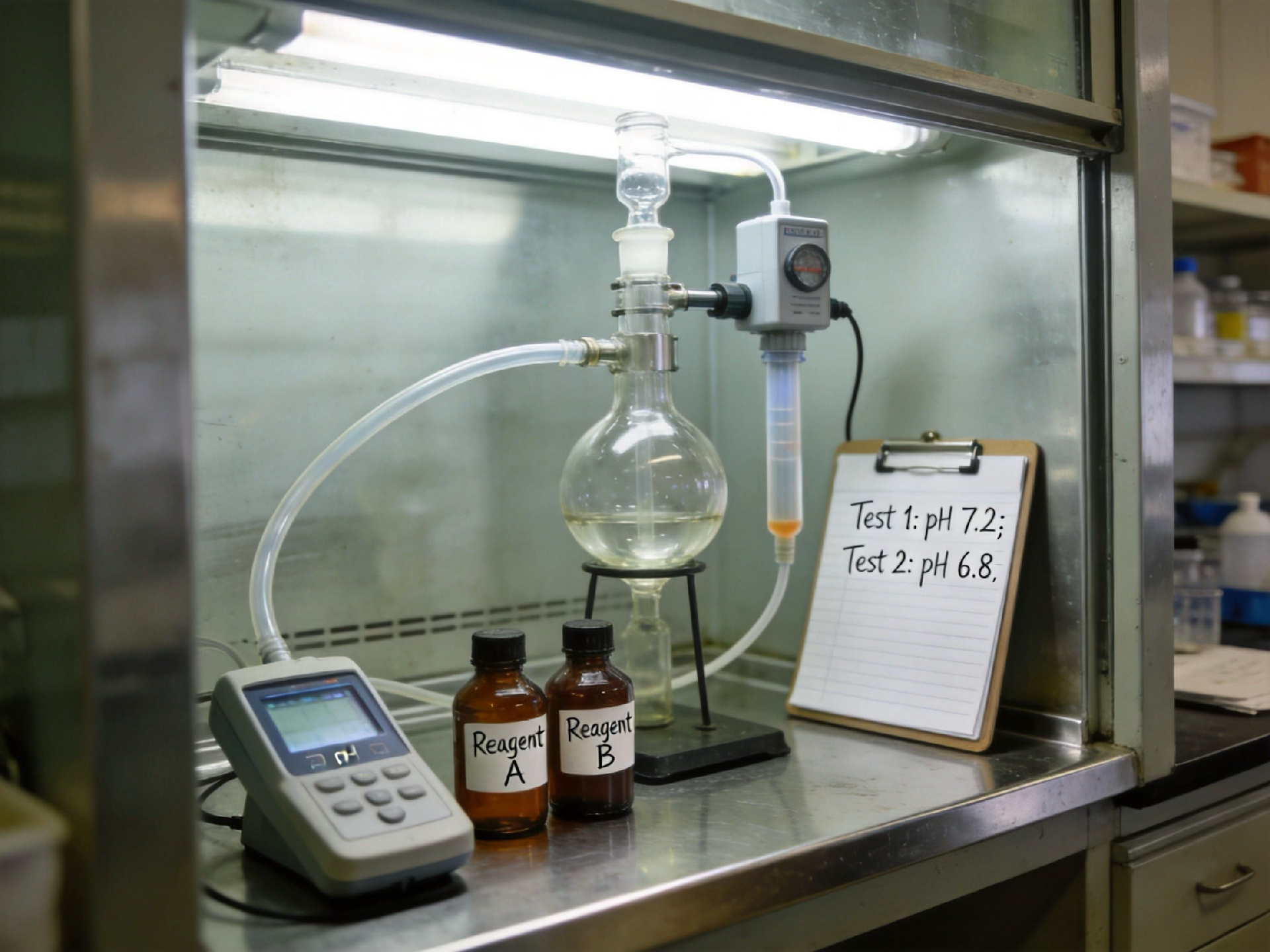
Laboratory screening of scavenger candidates. Residual H₂S is measured against dose at the field’s actual temperature — performance quoted at 20 °C tells you very little about a contactor running at 60 °C.
The Triazine Problem: Dithiazine Fouling
Here is the part most product datasheets skip. When a triazine molecule reacts past its two-H₂S capacity — or when it meets very high H₂S concentrations, low temperatures, or long residence times — it can over-react into dithiazine, an amorphous, waxy, nearly insoluble solid. Operators know it as the stuff that plugs filters, blocks sample points, coats contact-tower internals, and eventually forces a shutdown to dig out.
Most fouling problems trace back to one of three root causes:
Over-dosing — running excess triazine "to be safe" actually pushes the reaction toward the solid by-product
Cold systems — below about 10–15 °C the reaction products get viscous and dithiazine drops out more readily
High inlet H₂S with poor distribution — local zones see far more H₂S than the bulk chemistry can hold
The fixes are operational: dose to measured residual rather than a fixed rate, keep contact temperature reasonable, ensure good gas–liquid distribution in the tower, and watch the pressure differential across filters as an early warning. Where the chemistry itself has to change — typically in very high-H₂S or cold-oil applications — oil-soluble MMA-triazine (made from methylamine rather than ethanolamine) produces far less solid and stays in the hydrocarbon phase. It costs more per litre, but it’s the correct tool when MEA-triazine keeps fouling.
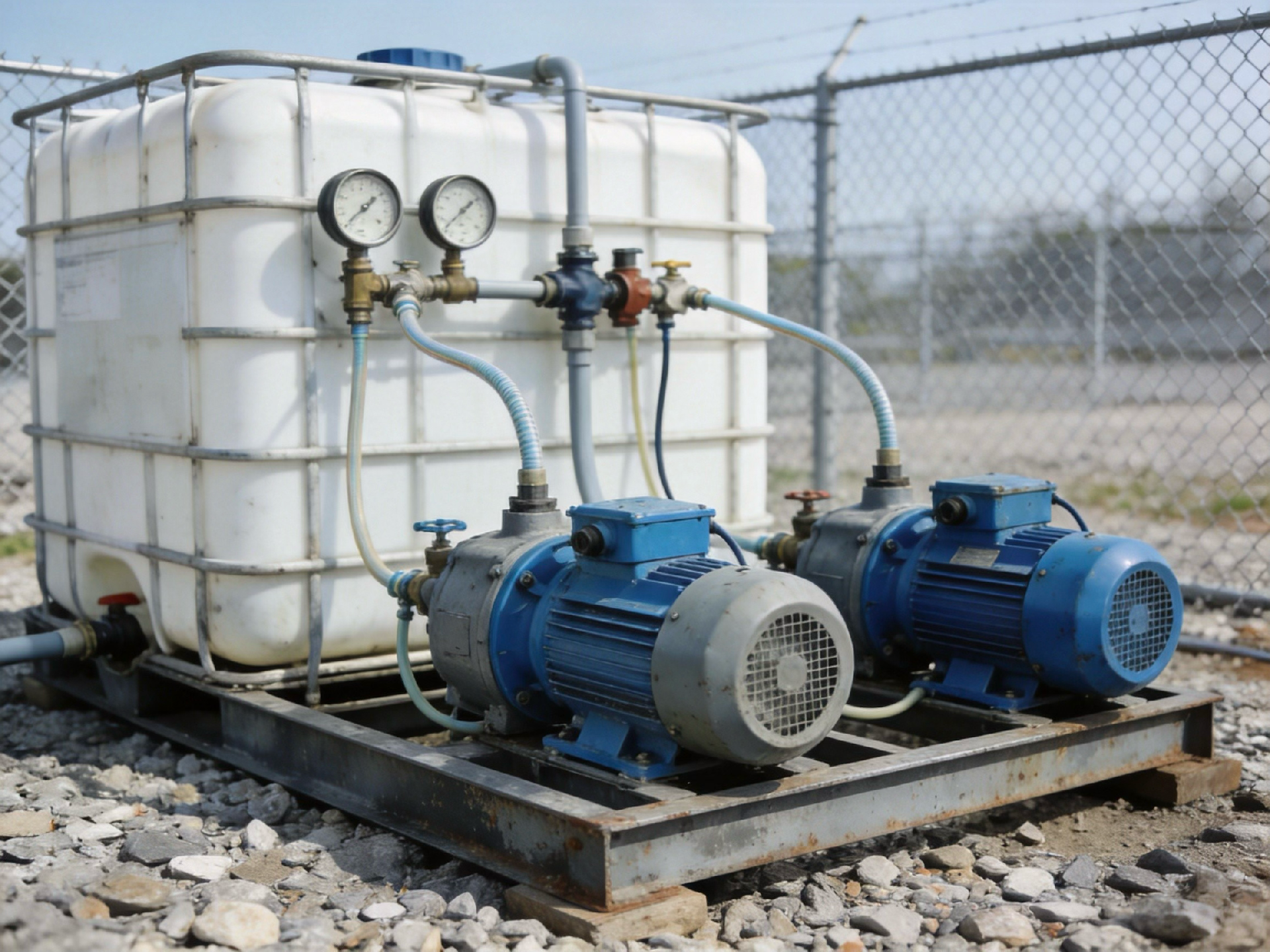
Chemical injection skid at a wellhead. Batch and continuous injection programs live or die on pump calibration — a scavenger program that isn’t metered against measured gas rate is how operators either waste chemical or create fouling.
The Other Non-Regenerative Options
Zinc oxide (ZnO) beds. Solid media in a pressure vessel; H₂S reacts to zinc sulfide. Polishes gas to extremely low residuals and tolerates high temperature, but the media is spent once loaded and has to be disposed of as sulfur-containing waste. It’s mainly used as a polishing step or for small dry-gas streams — not as the workhorse on wet, high-rate production.
Solid oxidizing media (iron oxide / iron sponge type). Cheap and forgiving on low-rate, low-pressure gas, but bulky, labour-intensive to change out, and pyrophoric when spent — spent beds can self-heat on contact with air. Proper handling procedures are non-negotiable.
Aldehydes and nitrite-based chemistries. Some older programs use formaldehyde or nitrite formulations. They have a place in specific water-treatment applications, but the handling hazards (formaldehyde is a known carcinogen; nitrites are strong oxidizers) mean most operators now default to triazine for personnel-exposure and environmental reasons.
Oil-soluble alternatives. Beyond MMA-triazine, a range of proprietary oil-soluble scavengers exists for direct-casing or capillary-string injection in high-temperature wells. Selection here is driven by bottom-hole temperature and whether the product has to survive the trip to depth.
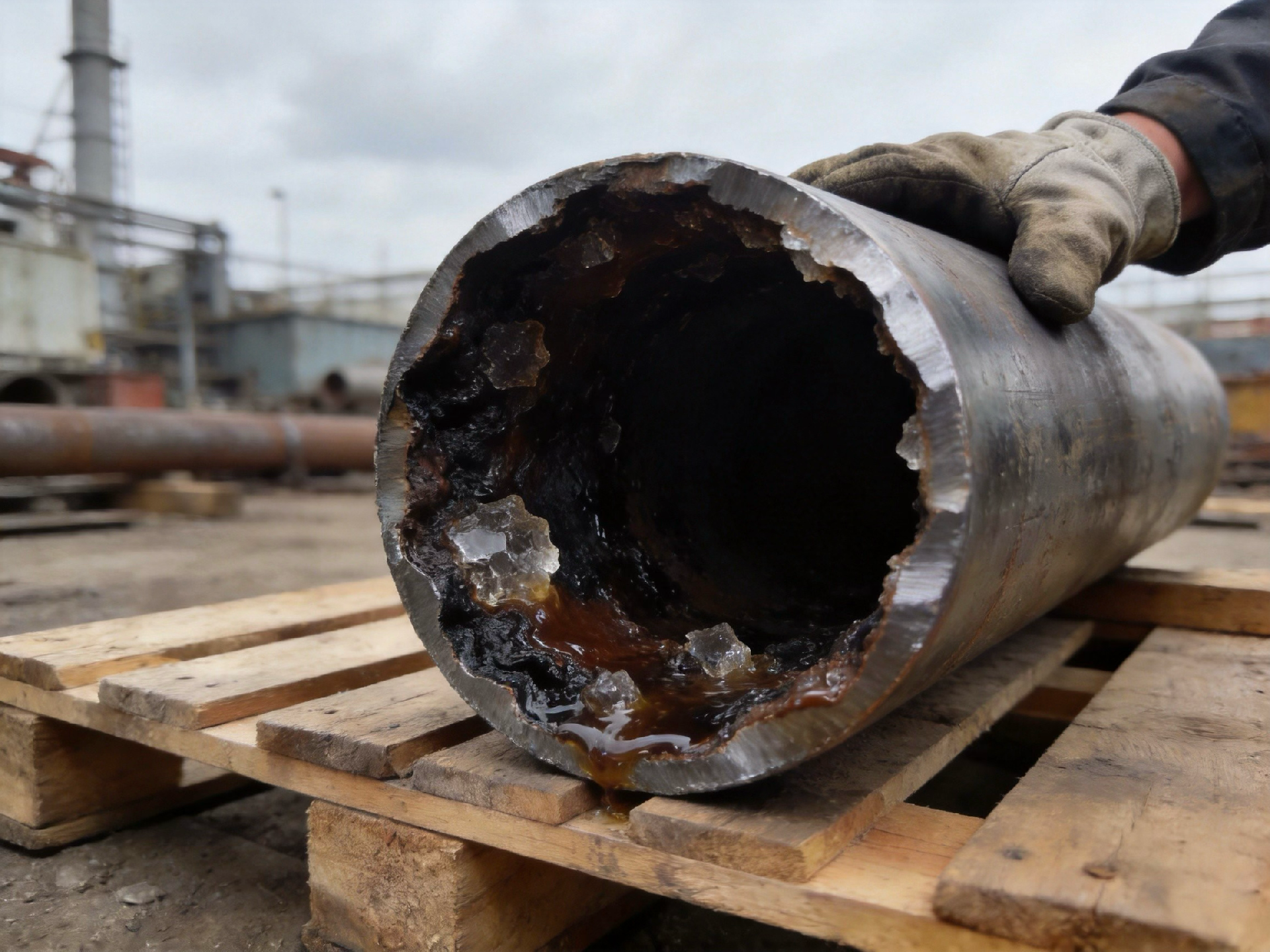
Deposit recovered from piping during inspection. Solid reaction by-products — dithiazine from over-reacted triazine, or spent media fines — are the hidden operating cost of a poorly matched scavenger program.
Five Questions We Ask Before Recommending a Program
Inlet H₂S concentration and gas rate. ppm times volumetric flow gives the sulfur load — this decides regenerative vs non-regenerative, and triazine vs a solid bed.
Target outlet specification. Pipeline spec is commonly 4 ppm H₂S; some LPG or petrochemical feed contracts demand far less. The deeper the cut, the more contact time and chemical are required.
Operating temperature. Sets triazine grade and predicts fouling risk. Cold systems need different handling than 60–80 °C contact towers; hot downhole injection needs an oil-soluble high-temperature product.
Contact time and equipment available. Direct injection into the flowline relies on line residence time. A packed contact tower with 2–5 minutes of contact lets the same chemical achieve a far deeper cut at lower dose.
Fouling history and waste route. If the site has previously fouled on triazine, or if produced-water disposal chemistry is sensitive, the recommendation changes — sometimes toward MMA-triazine or a solid polishing stage.
What We Supply
We supply a full non-regenerative H₂S scavenger line for oilfield and gas-processing applications:
MEA-triazine (water-soluble), 40–60% active. The standard workhorse for contact towers and continuous injection in gas and produced-water systems.
MMA-triazine (oil-soluble). For high-H₂S, cold, or fouling-prone systems where dithiazine from conventional triazine is a known problem.
Oil-soluble high-temperature scavengers. For downhole capillary and casing injection in hot wells.
Application support. Dose-rate calculation against your measured gas rate, injection-point review, and fouling diagnostics if an existing program is underperforming.
All products are supplied with TDS, MSDS, and COA per batch. Dosing recommendations are based on the field’s actual inlet concentration, temperature, and contact time — not on a generic datasheet figure — because that is the only way to hit deep outlet specs without wasting chemical or creating solids problems.
Send us your inlet H₂S level, gas rate, temperature, and target outlet spec. We’ll calculate the scavenger requirement and recommend the right chemistry and injection setup.
Request a Technical Assessment →
This article reflects our application team’s field and lab experience. Scavenger performance depends strongly on gas composition, temperature, and equipment design — the concentration ranges, thresholds, and removal figures cited are typical values, not guarantees. For a specific sour-gas problem, we’re glad to review the actual operating data.